

The expansion of mass tourism in the 90s fostered globalization, inducing a blend in cultures. If multiculturalism is an opportune aspect of the economic globalization, it is also a challenge for human interaction and communication.
As an Erasmus year becomes the norm in French higher education programs and the international collaborations intensify during the professional life, one may wonder:
How can people from different cultures communicate and cooperate effectively despite the language barriers, and the various cultural styles?
This third article of the Multiculturism series explores the width of culture, and a tool one can use to seize culture differences.
What is culture ?
- How deep is your norm ?
- The visible part of culture
- Deep culture: the invisible part of culture
- How to improve your understanding of culture
- Geert Hofstede’s shortcut to understanding deep culture
How deep is your norm?
It’s often difficult to know where to start when trying to improve cultural understanding and awareness. Culture is so deep!
In 1976, Edward T. Hall was comparing culture to an iceberg: with only about 10% of culture being easily visible and the large remaining 90% being hidden below the surface.
The visible part of culture
When two people from different cultures first meet, they usually interact only with the tip of the iceberg.
- The tip of the iceberg is the visible part of culture. It is everything what your professors will have told you about before you leave your home country: the language, cuisine, geography, greetings and general politeness, the music, clothing, and traditional arts, among others.
- It is anything that is easily observable with touch, taste, smell, or sound.
- Anything that is objective knowledge (hence taught at school) and conscious.
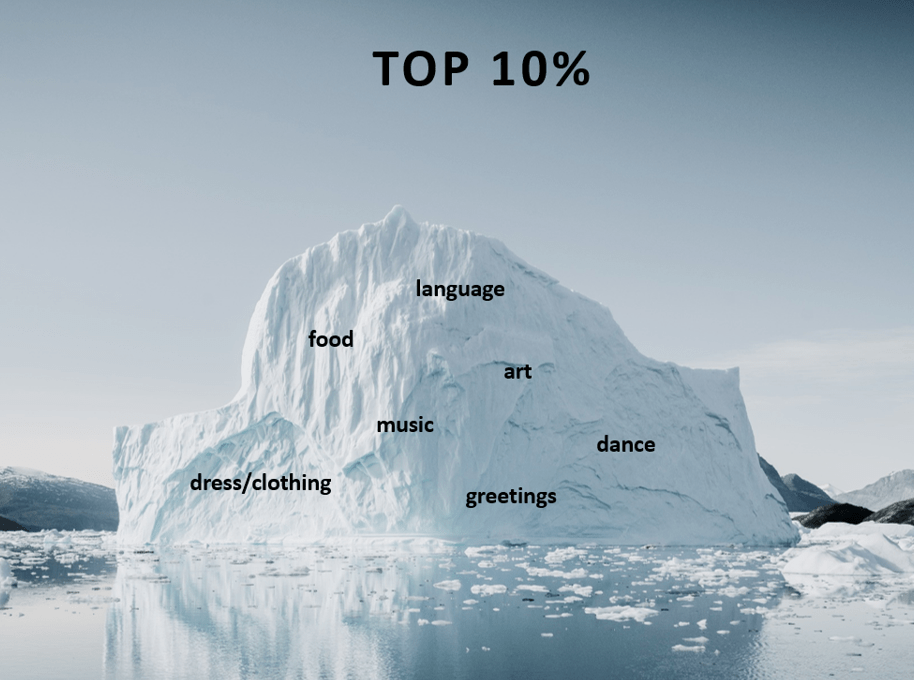
Those cultural references are a very good start, they will help you get a global picture of where you land. They will flatter your future friends and reassure them that you have been curious about their culture. Probably, in some ways, they will also help you to blend in and experience the trip in the local way.
But while you are living in your host country and talking to native speakers, you might realize that you do not quite understand them. I am not referring to the language or vocabulary here, but rather to the hidden part of culture. The deep references that you do not get to learn in school.
Deep culture – the hidden part of culture
Sometimes, we judge and make assumptions about another cultural community. We jump to conclusions easily because we use our fast brain. We process information and general cues and treat them with our usual cultural standards.
We forget that 90% of one’s culture lies under the water! We do not realize that my cultural standards are not necessarily the same as my interlocutor. Deep culture is all about the internal ideas that make up most of the culture’s values and beliefs.
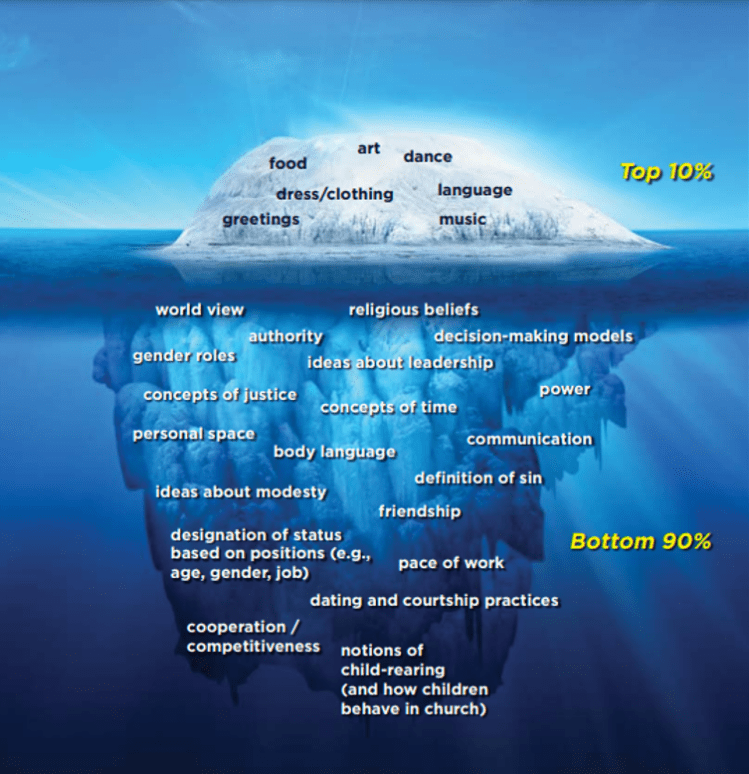
- Deep culture is concerned with the values, cultural codes, and body behaviours. It goes all the way down to the definitions of justice, politeness, sin, or insanity.
- It goes as sharp as defining what is your word ethic, eye behaviour or definition of some interpersonal relationships.
- Deep culture is everything that is implicitly learned, subjective and unconscious.
Discovering and understanding the deep culture is a long way to go. It requires genuine curiosity and time. From the classroom, to a job, to a neighbourhood, city, region, or country, there is always so much culture to learn.
How to improve your understanding of culture.
There are many ways to improve your cultural understanding.
Reading, asking questions and debating with locals, watching local news and movies, checking advertising and analysing what the emphasis is made on, joining cultural events…
Listening to kids, scanning the web, catching the pop culture references, and searching where an idiom comes from, what does a popular meme refers to, or why some celebrity is so adored by locals.
You get to understand things as you come across them, so do not be shy, ask as many questions as needed! This is what Geert Hofstede did.
Who was Geert Hofstede ?

Employed at IBM International, Geert Hofstede was a manager of the Personnel Research Department. As part of his research, he conveyed and analysed opinion surveys in over 70 national subsidiaries of IBM around the world.
With over 100,000 questionnaires and cross-national answers, his database was one of the largest in existence, allowing his teams to delve into and uncover organizational culture, cultural economics and management.
His team results evidenced significant differences between cultures from one IBM subsidiary to the other and initiated a classification of answers by countries. His pioneer work demonstrated that national and regional cultural references influence the behaviour of societies and organizations. If you want to know more on Geert Hofstede career and research, find his Wiki page here.
Geert Hofstede’s shortcut to understanding deep culture
As a leading expert in cultural values classification, Geert Hofstede tried the forbidden. Gathering all his knowledge in one tool, he crafted a shortcut to deep culture.
His model aims at helping to explain the basic value differences in culture. The model distinguishes cultures according to the following five different dimensions:
- Power distance
- Individualism/collectivism
- Masculinity/femininity
- Uncertainty avoidance
- Indulgence
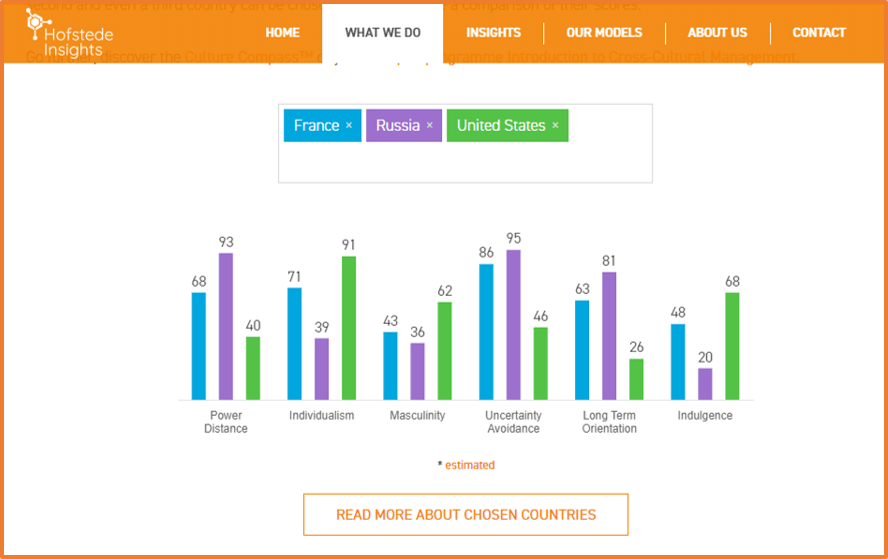
The way it works is simple.
You select a country from a dropdown menu, and it shows the values your country gets for each of the 6 dimensions. You can also read detailed explanations about the results and most importantly select a second or even a third country to compare their scores.
If the experience seduces you, here is the link to Hofstede’s tool.
Have a try and let me know what you think!
Cultural references gather people.
We seek in the other one (a commercial, professional, friend or love relationship) for something to relate to: “Birds of a feather flock together” goes the saying.
This is one of the most entrenched and powerful cognitive biases: we trust more easily people that we look alike. In a world packed with uncertainties, common references are reassuring. They allow us to be immediately understood and if the other one shares a common reference, maybe does he/she share a wider common ground too?
This is where deep culture may prove you wrong!
To me diving into cultural diversity is golden as you are never done truly understanding it. It is like taking an infinite tour for perpetual discoveries and uncovering!

Isn’t it exciting?
Thank you for reading!
This is the third article in a series written for NationsOrg. Every second week, we try to approach the subject of multiculturalism through the fields of sociology, psychology or management with one aim: taking a step back on the challenges expats meet. Find the previous article about the Power of Music.
 Allez Venez